
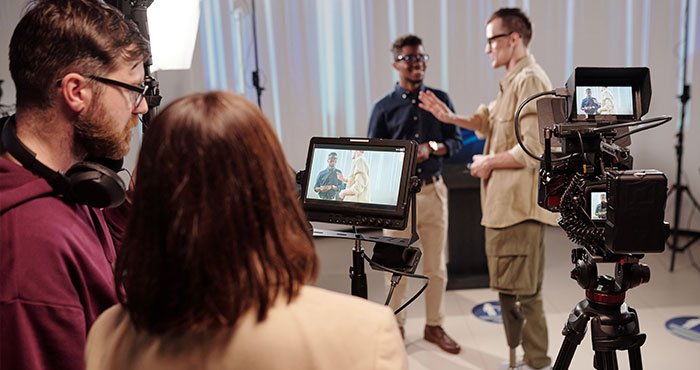


Psychosocial hazards such as excessive job demands, poor support, unclear roles and workplace conflict can be difficult to explain through policies and written guidance alone. These risks often develop through everyday interactions and working conditions, making them harder to recognise.
Video can bring these concepts to life through realistic workplace scenarios, demonstrating how hazards may arise and how employees and managers can respond. It also helps deliver consistent training across teams and gives employees a shared starting point for discussion.
In this article, we explore the benefits of video for psychosocial hazards training and how it can support workplace learning.
Why Use Video for Psychosocial Hazards Training: A Quick Overview
Video can help organisations:
- Turn abstract risks into realistic workplace examples
- Demonstrate respectful conversations
- Show how different people may experience the same situation
- Explain reporting and escalation pathways clearly
- Deliver consistent training across teams
- Support employees with different learning preferences
- Make sensitive topics easier to approach
- Reuse and update training content over time
Video is effective because it brings explanation, demonstration and context together in a single learning experience.
Make Psychosocial Hazards Easier to Recognise and Understand
Some workplace hazards are easy to spot, such as a damaged cable or blocked emergency exit. Psychosocial hazards can be harder to recognise because they develop through behaviour, communication and working conditions.
For example, ‘poor support’ may sound vague in a policy. Seeing how it appears in a workplace scenario makes the risk easier to understand.
A video might show an employee repeatedly asking for guidance while their manager keeps postponing the conversation. Priorities remain unclear, leaving the employee to make decisions without enough information. This gives employees and managers a concrete example of how inadequate support can contribute to psychosocial risk.
Video can also help distinguish ordinary workplace pressure from situations that may create an ongoing risk. A temporary increase in workload with clear priorities and additional support differs from excessive demands that continue for months without adequate resources or communication.
Comparing these situations helps viewers understand that psychosocial risk can depend on factors such as duration, intensity and available support, rather than the existence of pressure alone.
Realistic scenarios can also make sensitive topics easier to approach. Training may cover:
- Bullying and harassment
- Workplace conflict
- Excessive workload and low job control
- Poorly managed organisational change
- Exposure to distressing events
Video allows organisations to explore these issues without requiring employees to disclose personal experiences during training.
For example, a short scene could show two employees receiving conflicting instructions from different supervisors. The training could then explain what the hazard is, why the situation may create risk and what steps the employees and managers can take.
This approach makes the lesson relevant without asking participants to draw on their own experiences.
Demonstrate Appropriate Responses Through Realistic Scenarios
Recognising a psychosocial hazard is only part of effective training. Employees and managers also need to understand how to respond when a concern arises.
Written guidance can tell a manager to have a supportive conversation, but that instruction may leave room for interpretation. Video can demonstrate:
- How a manager opens the discussion
- What language they use to address concerns
- How they listen and respond
- What assumptions or comments they should avoid
- How they explain the next steps
For example, a manager can focus on observable workplace facts and the employee’s concerns rather than making assumptions about their mental health. This gives viewers a clearer model of respectful communication.
Video can also show what happens after an employee raises an issue. A scenario might follow this sequence:
- An employee identifies a workplace concern.
- They raise it through the appropriate reporting pathway.
- A manager listens and clarifies the issue.
- The matter is reviewed or escalated where necessary.
- Appropriate risk controls are considered.
- Follow-up occurs to assess whether further action is needed.
Showing this process can reduce uncertainty about reporting concerns and help employees understand what to expect. It also allows organisations to demonstrate their actual procedures rather than relying on generic examples.
The scenarios should reflect the organisation’s reporting pathways, responsibilities and available support. This helps employees and managers connect the training to situations they may encounter at work.
Deliver Consistent and Accessible Training
Psychosocial hazards training can become inconsistent when different managers explain the topic in different ways. One may focus on mental health awareness, another on performance, and another on policy requirements.
A professionally produced video can establish a consistent baseline across the organisation. Employees can receive the same core information about:
- What psychosocial hazards are
- Which risks are relevant to their workplace
- How concerns can be raised
- Where support is available
- What managers are expected to do
This is particularly useful for organisations with multiple locations, shifts or departments. Video can provide a shared foundation for further training and discussion without replacing those activities.
It can also present information in different ways within the same resource. Depending on the topic and audience, training videos may use:
- Narration and live-action scenarios
- Animation and diagrams
- On-screen text and visual summaries
- Captions and transcripts
For example, a live-action scene could show workplace conflict while a simple graphic explains the relevant hazard and available reporting pathways. Rather than relying entirely on written definitions, employees can see the situation and follow the explanation.
Video can also make workplace policies easier to understand. Psychosocial risk policies may contain legal, work health and safety (WHS) or human resources (HR) terminology that employees do not use in everyday conversation. A training video can explain these concepts through familiar workplace examples while directing employees to the relevant formal policies when needed.
Accessibility should be considered during production. Useful features include:
- Accurate captions
- Clear audio
- Readable on-screen text
- Strong visual contrast
- Clear, straightforward language
- Transcripts where appropriate
These features can support employees with different accessibility requirements and help workers who need to view training in noisy environments or prefer to read along while listening.
Tailor Training to Different Roles and Needs
Employees and managers often need different information, so a single training video may not address every responsibility in sufficient detail.
A general employee module might focus on:
- Recognising workplace risks
- Raising concerns and following reporting pathways
- Understanding available support
A manager-focused module could cover:
- Consultation and workload allocation
- Recognising potential warning signs
- Having appropriate conversations
- Escalation responsibilities and risk controls
Creating separate modules allows organisations to give each audience relevant information while keeping the overall messaging consistent.
The format can also be adapted to suit the subject. Live-action video is useful for demonstrating workplace interactions, while animation can explain concepts that are difficult to film.
For example, an animated sequence could show how repeated high job demands, unclear priorities and limited support can interact over time. Animation can also illustrate organisational processes, reporting pathways and risk-control frameworks. It may be particularly useful when privacy or the sensitivity of a topic makes live-action scenes difficult to produce.
Video modules can also be reused for refresher training. Organisations may need to update employees when:
- Procedures or reporting contacts change
- New psychosocial risks emerge
- Organisational structures change
- Employees move into management roles
Short, targeted videos can reinforce specific information without requiring employees to repeat an entire training program. This works best when the original content is planned in modules that can be updated individually.
Keep Training Content Accurate and Relevant
Video is only effective if the information it presents is correct. Psychosocial hazards training should be developed with input from appropriate internal stakeholders, which may include:
- WHS personnel
- HR representatives
- Managers
- Subject matter experts
- Other qualified advisers
The scenarios should reflect genuine workplace risks, and the response pathways shown should match the organisation’s actual systems.
The content also needs to distinguish between recognising a psychosocial hazard, understanding its potential risks and identifying appropriate control measures. Employees should not be left with the impression that awareness alone is enough to address workplace risks.
Strong production cannot compensate for inaccurate content. The best result combines professional video with sound workplace knowledge, relevant examples and clear guidance on what employees and managers should do.
Final Thoughts
So, why use video for psychosocial hazards training? Because psychosocial risk often depends on context.
Video can show how excessive workload, poor support, unclear roles, workplace conflict and organisational change may appear during everyday work. It can demonstrate respectful conversations, explain what happens after concerns are raised and make complex workplace concepts easier to understand. It also gives organisations a consistent, reusable training resource that can support employees and managers across different locations and roles.
When the content reflects the actual workplace, video can help turn psychosocial hazard education from an abstract compliance topic into training employees can recognise and apply.
Ready to Create Psychosocial Hazards Training Videos?
Channel 1 Creative Media produces workplace training videos that help organisations communicate complex topics clearly and effectively. We can work with your WHS, HR and subject matter experts to develop scripts, realistic workplace scenarios, animation and live-action content tailored to your workforce, policies and procedures.
If you’re planning psychosocial hazards training for your organisation, call us on 0387430488 or visit our Contact Us page to discuss your project. We can help you develop engaging video content that helps employees and managers recognise psychosocial hazards and understand how to respond appropriately.